
Several leading industrialists, including Reliance Industries CMD Mukesh Ambani, Vedanta Resources Limited executive chairman Anil Agarwal, chairman emeritus of Tata Sons Ratan Tata, Mahindra Group chairman Anand Mahindra, Paytm Founder and CEO Vijay Shekhar Sharma, Welspun Group chairman and Assocham president B K Goenka, attended the swearing-in ceremony.

Take a look at the famous faces who exercised their democratic right.

The Reserve Bank on Friday retained the real GDP growth projection at 9.5 per cent for 2021-22 as domestic economic activity has started normalising with the ebbing of the second wave of the virus and the phased reopening of the economy. In the June monetary policy, the RBI had lowered the growth projection for 2021-22 to 9.5 per cent from 10.5 per cent estimated earlier. Unveiling the bi-monthly monetary policy, RBI Governor Shaktikanta Dad said high-frequency indicators suggest that consumption (both private and government); investment; and external demand are all on the path of regaining traction.

The country had imported 5.5 million tonnes of pulses last year.

'RBI is taking all steps to complete the process expeditiously so as to release firm figures at an early date.'

An expected withdrawal of FIIs from the market likely to weaken the rupee against the dollar.

'In the real economy, the scars of the pandemic will continue to define 2021.' 'It is still hard to tell the effect on unemployment, migrant workers, poverty, and the informal sector of the lockdown and of the pandemic,' observes Mihir S Sharma.

Capital markets regulator, I-T department suspect tax evasion and market manipulation

Since April, India has seen multiple strains of the coronanavirus sweep the nation, upending life and businesses alike. Out-of-home retail and discretionary categories such as durables, auto, fashion, lifestyle, hospitality, food services, travel, and tourism have been the worst-hit as Covid cases remain high, leaving state governments with no option but to curtail mobility and economic activity.

Rajan said investments should return after initial investor worries over Brexit.
Arun Jaitley addressed a post-Budget press conference.
The Centre's proposal to call for governance reform in the RBI could, however, take a back seat, a source privy to the development said.

Last month, the bank was placed under Prompt Corrective Action due to high level of bad loans, lack of sufficient capital to manage risks and negative return on assets for two consecutive years.
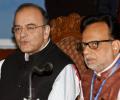
Finance Secretary Hasmukh Adhia vacates his post on November 30 and Expenditure Secretary Ajay Narayan Jha, the second seniormost bureaucrat in the finance ministry, retires on January 31, the day before Jaitley presents the 2019-20 interim budget.

Today, the single most popular route of laundering is the stock market platform, notes Debashis Basu.

'Trust your new governor,' Omkar Goswami advises RBI Deputy Governor Viral Acharya. 'Just because he is from the IAS and doesn't carry a PhD from a US university does not make him unsuitable for the task.' 'If anything, Das will pour oil on troubled waters, and save the RBI's reputation.'

Earlier, the RBI cut its policy interest rate to 6.75 per cent.

Many banks' profits will take a hit and a few of them could even end up being in the red because of treasury losses, triggered by a sudden spike in government bond yields in the rising interest rate cycle, notes Tamal Bandyopadhyay.

Some of the disclosures in the ITR form, under review at present, increases procedural hassles for expats

Governments that do not respect central banks' independence will sooner or later incur the wrath of the financial markets, ignite economic fires, and come to rue the day they undermined an important regulatory institution; their wiser counterparts who invest in central bank independence will enjoy lower costs of borrowing, the love of international investors, and longer life spans, said Acharya, who will return to the New York University's Stern Business School in August.

In a grand ceremony with overtones of a United States presidential inauguration, heads of state and government, India Inc honchos, opposition leaders, Bharatiya Janata Party members and showbiz stars rubbed shoulders as they watched President Ram Nath Kovind administer the oath of office to India's 58 new ministers.

While its deposits from Iran accounts have come down from a peak of around Rs 25,000 crore to Rs 2,200 crore, it's been offset by the bank receiving almost Rs 24,000 crore in deposits post note ban.

A memorandum, signed by the chief ministers or finance ministers of Andhra Pradesh, Puducherry, Karnataka, Delhi, West Bengal, Kerala and Punjab, said the terms were disruptive and a cause for concern.

Budget planners for now have been told to prepare with the assumption that GST will apply from April 1.

Over the past six months Rajasthan has introduced some of India's most radical free-market labour, land and welfare reform.

The most common complaint of financial consumers is cumbersome processes, complicated products, usurious charges, and mis-selling of products, which finally don't deliver what is promised or as expect, notes Debashis Basu.

India's economy recovered faster than expected in the September quarter as a pick-up in manufacturing helped GDP clock a lower contraction of 7.5 per cent and held out hopes for further improvement on better consumer demand. The gross domestic product (GDP) had contracted by a record 23.9 per cent in the first quarter of the 2020-21 fiscal (April 2020 to March 2021) as the coronavirus lockdown pummelled economic activity.

The future of cryptocurrencies in India appears uncertain but that has not deterred young Indians from embracing the so-called 'fourth industrial revolution' world, where interconnectivity and smart automation, much of it relying on blockchain technology, drive human civilisation. Reserve Bank of India (RBI) Governor Shaktikanta Das has repeatedly warned of macroeconomic instability and even "serious consequences" if cryptocurrencies turn mainstream. The country's monetary authority wants a China-like total ban on crypto, not even allowing these currencies to be treated as investments. Though Parliament's website had listed the Cryptocurrency and Regulation of Official Digital Currency Bill as one seeking a total ban of cryptocurrencies in the country, it was not presented in the Winter Session. India now has the highest number of cryptocurrency investors in the world.

The Central Bureau of Investigation (CBI) had told the finance ministry some "well-known" companies in the power, oil, and telecommunications sectors were involved in round-trip trading by indulging in third-party transfers in violation of law.

India's external firewalls were solid in the form of a healthy reserve position.

India has undertaken a number of structural reforms.

In another somersault, the BJP MP claims Arun Jaitley looks smart in a suit.

The Supreme Court asked the Centre and the RBI on Monday to place on record the K V Kamath committee recommendations on debt restructuring in view of Covid-19 related stress on various sectors as well as the notifications and circulars issued so far on loan moratorium.

Rules applicable from April 1, 2014; investors who have already redeemed will also have to pay tax

Tomorrow's review could also turn out be the last policy anchored by Rajan if the proposed Monetary Policy Committee (MPC) is put in place before the next review due on August 9.

Jaitley's team presents a quintessential mix of foreign-educated, intellectual technocrats and seasoned bureaucrats

A common feature in India is the lag between the occurrence of frauds and the time they are actually reported.

She also hit out at the government for posting retired bureaucrats, who she alleged were its 'yes men', as head of institutions.

For his first Budget in July 2014, Jaitley inherited a fiscal deficit target of 4.1 per cent of GDP. From 4.1 per cent, the fiscal deficit came down to 3.4 per cent by 2018-19, with two slippages from the budgeted targets, in 2017-18 and 2018-19, the former due to introduction of the GST, says Arup Roychoudhury.

A vast majority of borrowers are in the essential services' supply chain with tiny and micro businesses, and this has sprung back.
